
Corrections Consume Time, but Their Causes Vary
The document has been sent back for revision.
This could be due to a filling error, a product change requested by the buyer, an outdated source document, or a clarification of a new requirement.
The general line ‘document rework’ does not show which process change will help the company.
For management analysis, separate repetitive labour costs from calendar waiting time and external expenses.
They can be analysed together, but you cannot add hours and money into a single indicator without a clear methodology.
Let’s discuss the foreign trade team’s work in your company
I’ll help you analyse your situation: corrections get lost in the total hours and do not factor into process decisions.
We’ll discuss solutions to this and related foreign trade tasks in your company, the distribution of responsibilities, and next steps.
We’ll agree on the scope of support before starting work.
Define the Initial Action and Repetitive Work
Record what result was already prepared, what required a change, and who provided the rationale.
Indicate the actual additional time and the documents affected.
If the cause has not yet been established, note this: an assumption should not become a fact in the report.
Estimate labour costs only according to the agreed internal methodology.
Record any additional invoice from an external party separately with confirmation.
Do not record all the time until a response is received as the employee’s work cost.
ISO quality management principles serve as a guide for data-driven decisions; this log is not a certified ISO form.

Repetitive Work Log
The table is a training example without set rates and time standards.
| Entry | What to Confirm | Purpose |
|---|---|---|
| Initial Result | Document and version | To establish what has already been done |
| Basis for Change | Request or identified discrepancy | To separate fact from hypothesis |
| Repetitive Action | What was actually corrected | To assess the scope |
| Labour Costs | Additional time | To plan resources |
| External Expense | Documentary basis | To account for a separate amount |
| Process Change | Responsible party and verification | To avoid repeating the cause |
Illustrative scenario: the buyer changed the packaging after approval.
This is repetitive work, but it cannot automatically be considered an employee’s error.
Avoid Double Counting and Blame-Finding
One correction may affect several files, but the coordinator’s overall action should not be recorded in full in each of them.
Agree on accounting boundaries and maintain links between entries.
If the rationale is unclear, reconstruct the chain of versions and messages.
Do not close the analysis with the formulation ‘inattention’ without confirmation: the next batch may face the same incomplete source document.
Decide separately whether to change the template, approval process, or terms of working with the counterparty.
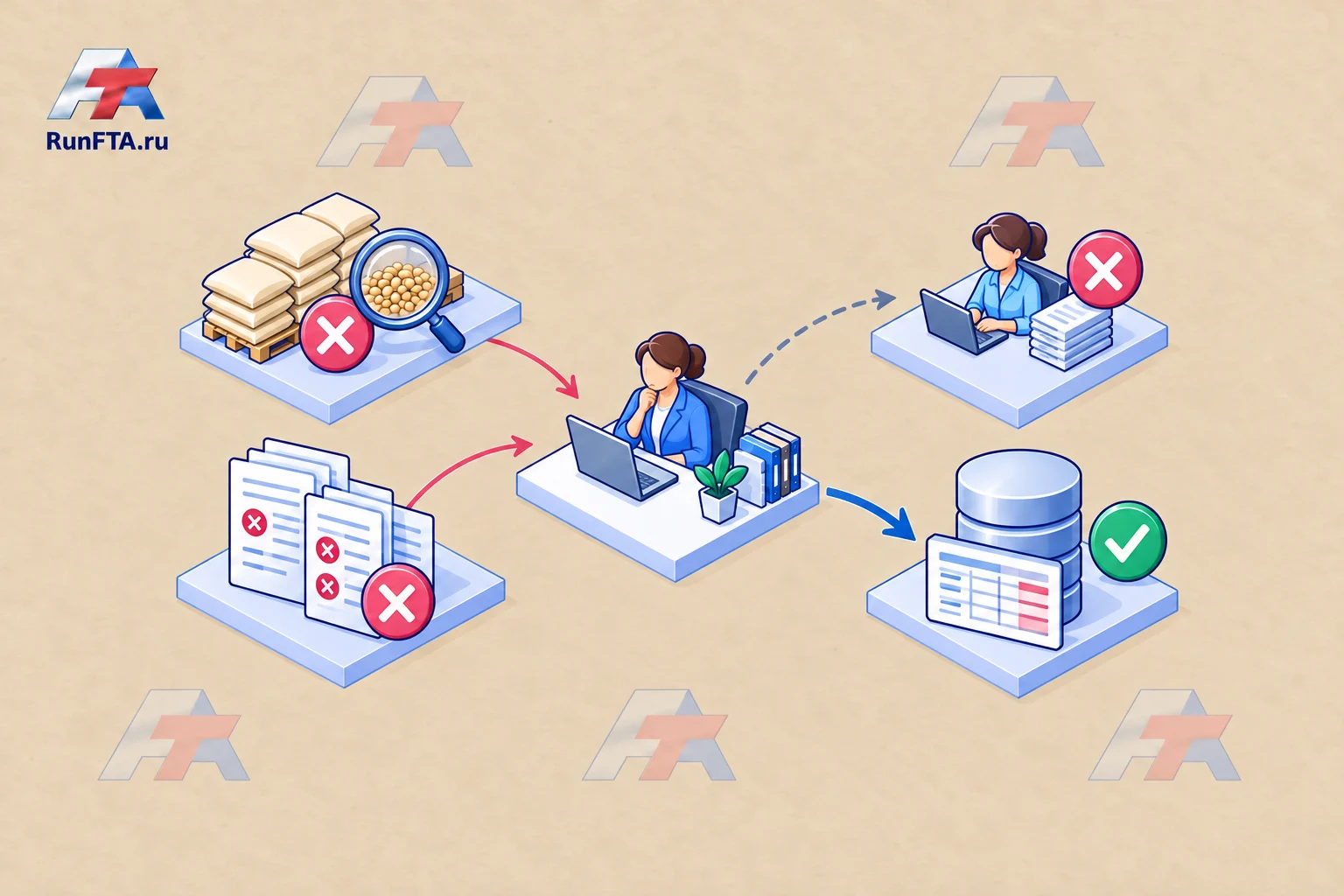
Verify the Effect on a Comparable Shipment
Select a recurring cause, assign one change and its owner.
On the next comparable batch, check whether this specific repetitive work has decreased and whether a new workload has appeared for another participant.
Store source document history in the document register.
The outcome of the analysis is a confirmed process change, not just a summary of hours spent on corrections.
A practical management guide.
All examples are illustrative.
Check applicable requirements and terms for the specific product, country and contract.
Sources checked on 24 October 2026.