
A Long Task Doesn’t Necessarily Involve a Lot of Work
An employee prepared a request, sent it to the bank, and waited for a response for several days.
If all this time is recorded as labour input, the manager will see an overload where the main limitation was external waiting.
If waiting is not taken into account at all, the reason for the long deal term will disappear.
Two scales are needed: the active work of the team and the calendar movement of the task.
They answer different management questions.
Let’s discuss the work of the foreign trade team in your company
I’ll help you analyze your situation: active employee hours are mixed with the calendar waiting time for the bank or buyer.
We’ll discuss solutions to this and related foreign trade tasks in your company, the distribution of responsibilities, and next steps.
We’ll agree on the scope of support before starting work.
Record Work and Waiting Separately
Active work includes preparation, verification, approval, and other completed actions.
Waiting is the interval until an external response or a necessary event.
Within the waiting period, there may be separate labour input for clarification and a repeated request; these are recorded as work, without turning the entire interval into working hours.
For waiting, specify who or what you are waiting for, the date of the last action, and the next control point.
For active work, specify the task, batch, and result.
The foreign service Harvest demonstrates the practice of time tracking by task, but the choice of tool itself does not separate these values.
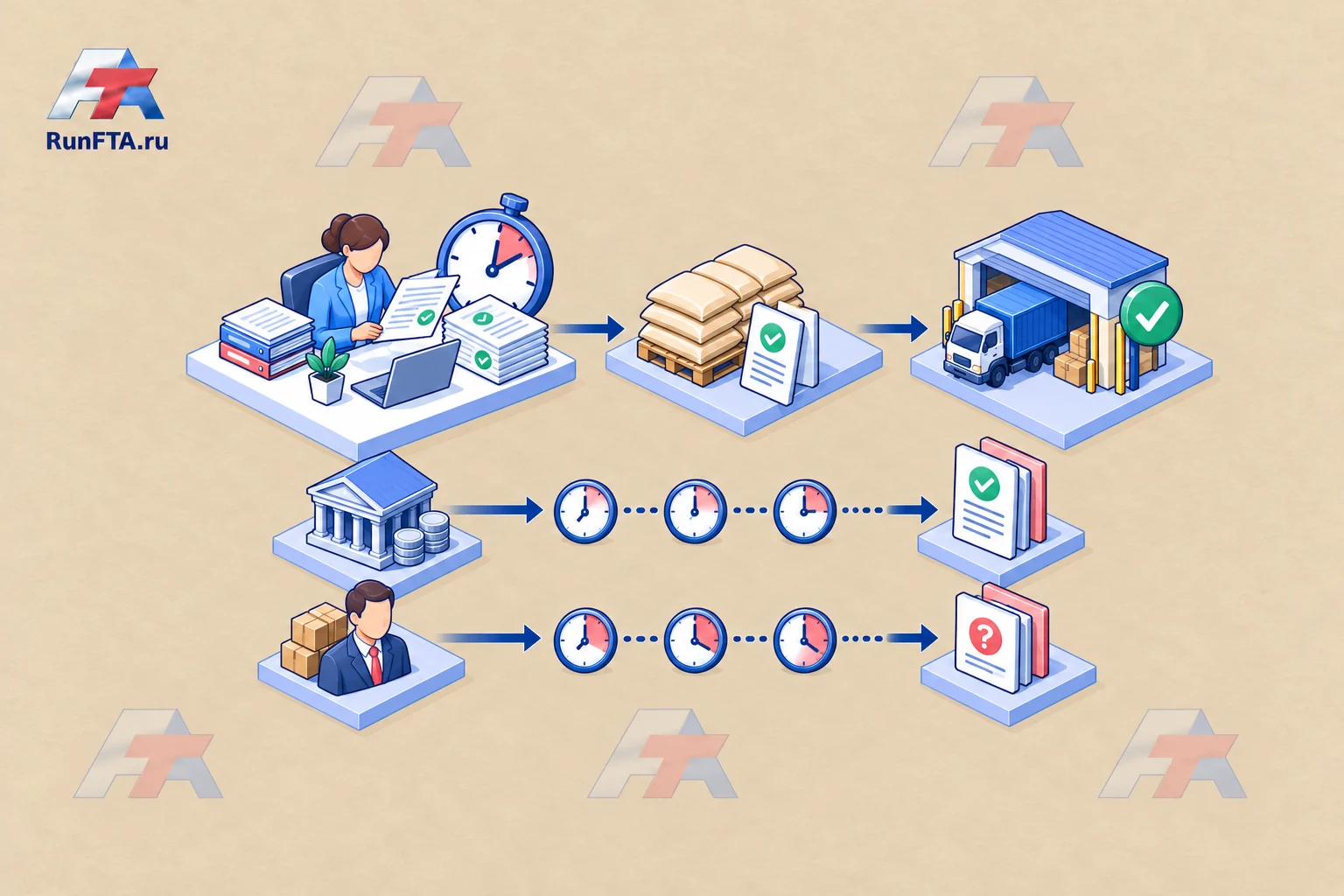
Two Entries Instead of One Long Timer
The educational example does not contain a time standard.
| Event | How to Track | Confirmation |
|---|---|---|
| Request for batch P prepared | Active work | Saved request |
| Request sent to the bank | Start of waiting | Confirmation the request was sent |
| Clarification made | Separate active work | Response or new request |
| Response received | End of waiting | Message and next step |
Do not leave the work timer running throughout the wait for an external reply.
If the tool has no waiting status, record waiting separately.
Reports must distinguish active hours from elapsed task time.
What to Investigate When There’s a Deviation
High labour input require analyzing complexity, rework, and missing data.
Long waiting periods require checking the responsible contact, the clarity of the request, and the agreed response time.
These are different solutions: training an employee will not eliminate external downtime, and reminding a counterparty will not fix rework.
Do not use hours without results as evidence of productivity or dishonesty.
Take into account the complexity of the task and the employee’s responsibilities, avoiding covert monitoring and constant screen captures.

Start with One Delivery Stage
Choose a stage where the timeline regularly raises questions.
Agree on definitions of active work and waiting, assign a status owner, and check several completed entries.
In the export deal card save the result of the action and the next control point.
The manager will be able to choose between changing the process within the team and working with an external participant based on different indicators.
A practical management guide.
All examples are illustrative.
Check applicable requirements and terms for the specific product, country and contract.
Sources checked on 24 October 2026.