
Revenue in currency does not show the open position
The contract is in one currency, the procurement is in another, and payments fall on different dates.
Even a shipment that is profitable according to the initial calculation may yield a different monetary result if the exchange rate changes.
To manage this, you need an amounts calendar, not a market trend forecast.
Materials from the International Trade Administration explain the risk of exchange rate changes between the transaction and payment using the example of American exporters.
Below is an independent accounting form for the company; the availability of foreign-exchange instruments and settlement methods in Russia is not assumed automatically.
Let’s discuss the currency amounts calendar in your company
I will help you analyze the currency amounts calendar, collect initial data and confirmations, identify participants and next steps.
We will also discuss similar challenges and related foreign trade tasks in your company.
The scope of support will be agreed upon before starting the work.
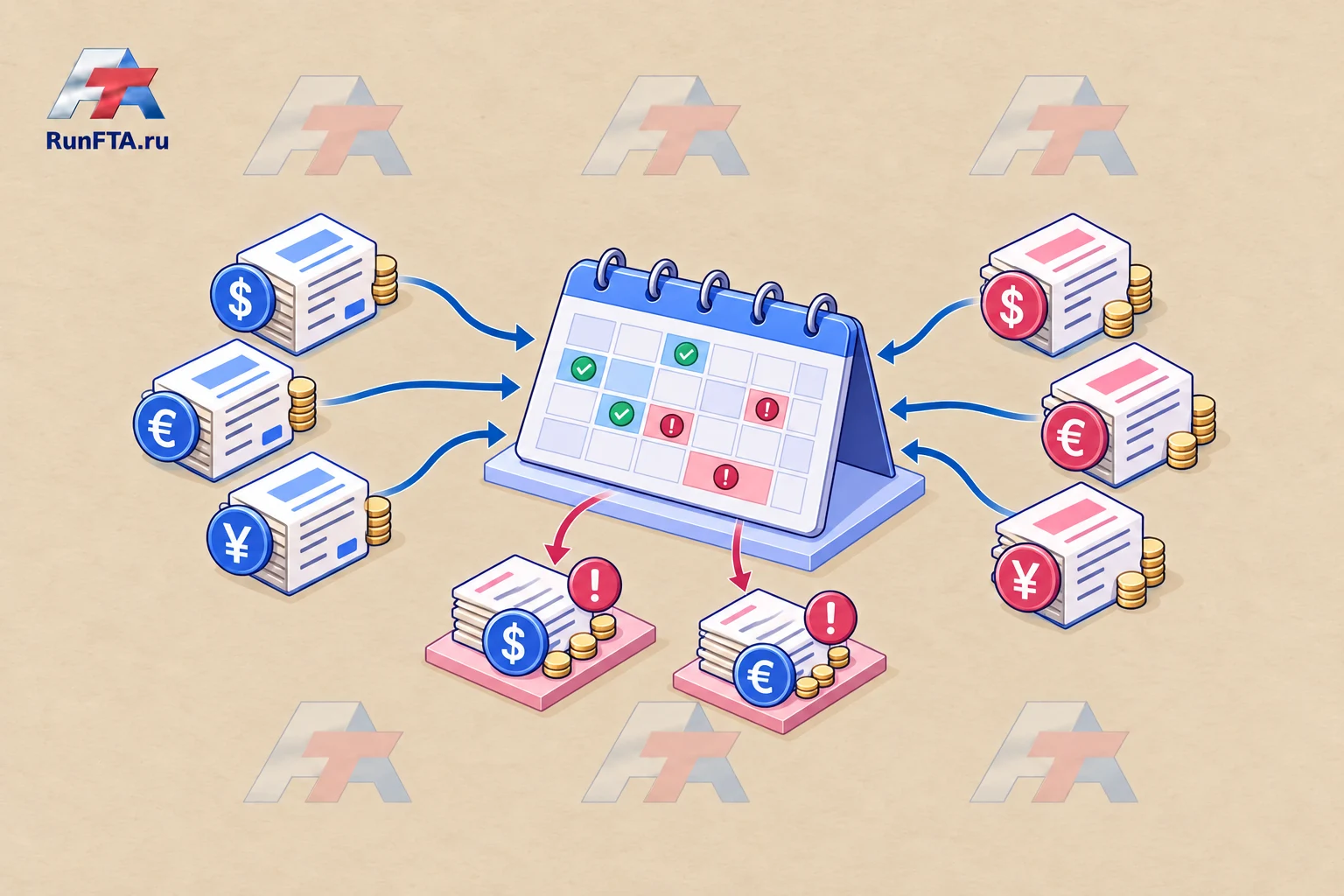
Align receipts and obligations by currency and date
For each flow, record the amount, currency, expected date, basis, and confirmation status.
Separately note the advance payment, the remaining payment, and already accepted obligations to suppliers.
The sales forecast does not equal a confirmed receipt.
Receipts and expenses in the same currency may partially match, but different timelines and uncertain amounts leave risk.
Do not call such a link full coverage without verification.
Actual banking terms, fees, and possible restrictions should be discussed with the servicing bank.
Illustrative cash-result sensitivity
Let’s assume 100,000 units of foreign currency are expected, and the hypothetical rouble expense is 7,500,000.
There is no currency forecast, taxes, fees, or currency recommendation here.
| Educational Rate | Rouble Equivalent of Receipt | Difference from Expense |
|---|---|---|
| 80 | 8,000,000 | 500,000 |
| 75 | 7,500,000 | 0 |
| 70 | 7,000,000 | −500,000 |
This is the sensitivity of a simplified scenario, not the accounting profit of the transaction.
For a real decision, include other expenses and cash flow dates.
Discuss action, not guessing the rate
Assign who will update the calendar and at what change will return the conditions for decision-making to the manager.
Possible changes in the schedule, currency, or instrument require coordination with the counterparty, bank, and relevant participants.
Do not promise protection just because the contract specifies a foreign currency.
Do not present foreign banking products as available to a Russian company.
The point of the calendar is to make the risk visible before the obligation, not to profit from fluctuations.

Link the position to the shipment’s cash plan
Update the record when the payment date, volume, or procurement changes.
Keep the original scenario and the reason for recalculation: changing one figure does not explain the decision.
Separately show the actual crediting and the expected amount.
Use the export shipment working capital plan.
It answers the question of when money is needed; the currency calendar adds in which currency and what part of the result still depends on the unknown rate.
A practical management guide.
Examples are illustrative.
Check requirements and contractual terms for the specific product, country and shipment.
Internal forms do not replace official procedures.
Sources checked on 25 October 2026.